Shorthand
1.050 in gravity points — the brewer's shorthand.

Brewing · Calculator
Enter original and final specific gravity to get ABV, apparent and real attenuation, gravity points, °Plato, and calories — live as you type.
Live calculator · updates as you type
Gravity points are the last three digits of specific gravity (1.055 = 55 points). Apparent attenuation uses raw gravity; real attenuation corrects for alcohol using degrees Plato, so it always reads lower.
From your OG and FG
What to do next
From an OG of 1.055 and FG of 1.012.
Free printable
A batch card made from your numbers, to save as a PDF or receive by email:
| Style | Typical OG | Typical FG | Attenuation |
|---|---|---|---|
| Light lager | 1.028–1.040 | 0.998–1.008 | 75–82% |
| Pale ale / IPA | 1.045–1.070 | 1.008–1.016 | 72–80% |
| Stout / porter | 1.045–1.075 | 1.010–1.022 | 68–75% |
| Saison | 1.048–1.065 | 1.002–1.008 | 85–95% |
| Dry wine / cider | 1.075–1.100 | 0.990–1.000 | 95–100% |
| Barleywine | 1.090–1.120 | 1.018–1.030 | 70–78% |
OG & FG guide
Every number that matters — alcohol, attenuation, calories — comes from the gap between OG and FG. This guide shows how to read it and what it means for your batch.
A 38-point drop — change readings live in the calculator below.
1.050 in gravity points — the brewer's shorthand.
A typical apparent attenuation range.
Real attenuation is roughly four-fifths of apparent.
ABV = (OG − FG) × 131.25 Att = (OG − FG) / (OG − 1)The gravity drop drives both alcohol and attenuation. Real attenuation and real extract add a Plato correction for the alcohol present.
Enter your original gravity and final gravity as specific gravity values — for example 1.055 and 1.012. The calculator immediately returns ABV, apparent and real attenuation, the gravity drop, real extract, and an approximate calorie count per serving.
Use it to confirm a batch has finished, to compare a reading against your target, or to record the numbers in a brew log. Everything recalculates live as you adjust either reading.
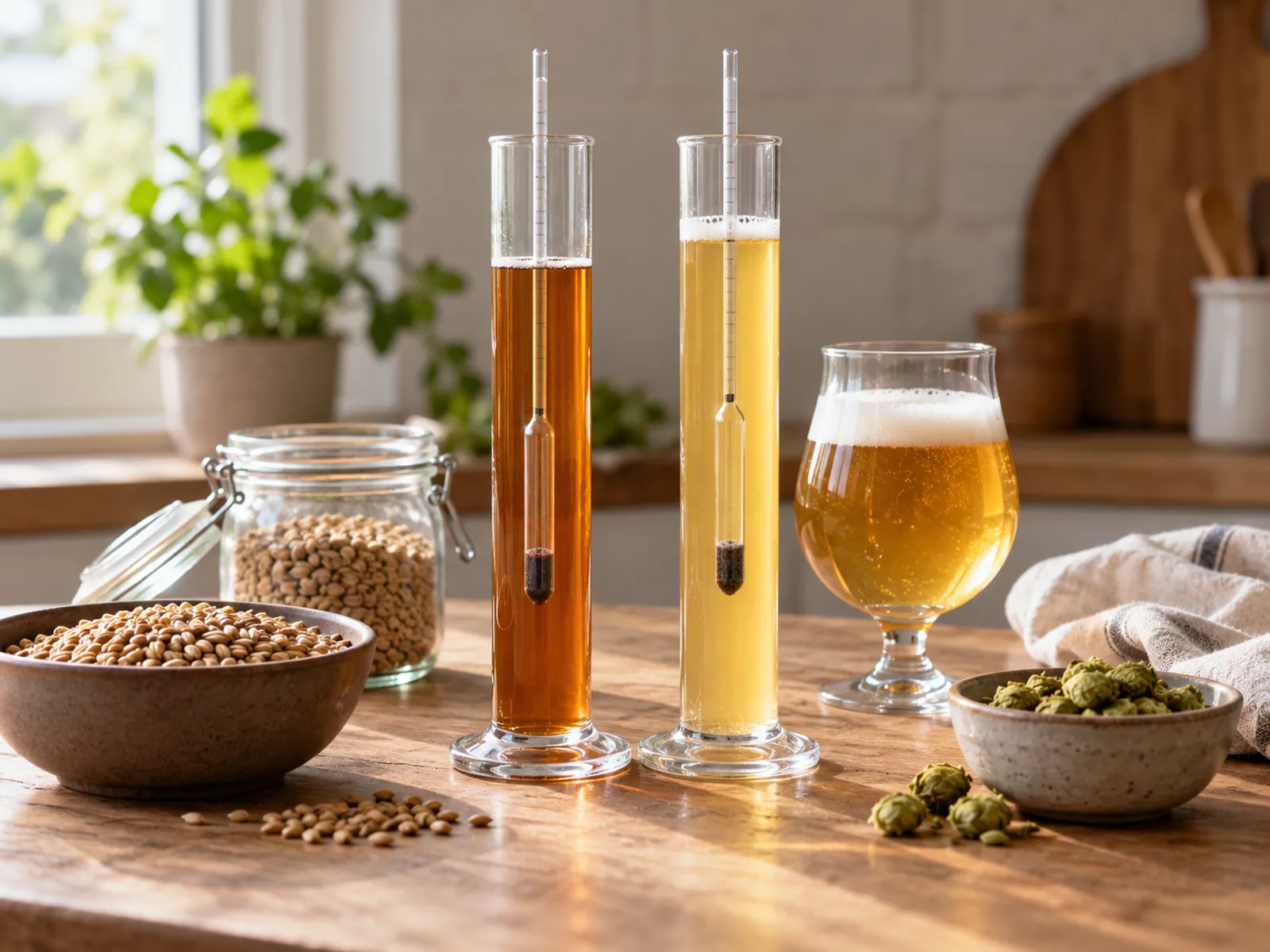
Specific gravity measures density relative to water at 1.000. Dissolved sugar makes wort, must, or juice denser, so a higher original gravity means more fermentable sugar and a higher potential alcohol content.
As yeast convert sugar to alcohol and CO₂, density falls. The gap between original and final gravity is the engine behind every other number on this page — alcohol, attenuation, and calories all derive from that drop.
Gravity points are the last three digits of specific gravity: 1.050 is 50 points. Brewers talk in points because it makes gravity drops easy — 50 down to 12 is a clean 38-point drop. The calculator shows points beside each reading.
Degrees Plato express the same sugar content as a percentage by weight and are common in professional brewing. Plato is what makes real attenuation and real extract possible, since those corrections are defined on the Plato scale.
Apparent attenuation comes straight from gravity and reads high because alcohol is lighter than water and drags the final gravity down. It is the number most brewers quote day to day.
Real attenuation corrects for that alcohol using Plato and always reads lower — roughly four-fifths of the apparent figure. It reflects the true fraction of sugar fermented, which matters for calorie and body calculations.
ABV is estimated as (OG − FG) × 131.25 — a bigger gravity drop means more alcohol. The calculator reports this instantly so you can confirm a batch hit its target strength before packaging.
Calories combine alcohol and leftover sugar into a per-serving figure. Drier beers with low final gravity have fewer calories than sweeter, higher-finishing ones at the same ABV, because residual sugar adds calories of its own.
OG (original gravity) and FG (final gravity) are the two readings that unlock everything about a finished batch. Enter both values and the calculator returns ABV, attenuation, real extract, and calories without any manual arithmetic.
Take the OG reading before you pitch yeast, and the FG reading when fermentation is complete (stable over two or three days). The bigger the gap, the more sugar converted to alcohol. A typical ale drops from around 1.050 to 1.010; a barleywine might start at 1.100 and finish near 1.025.
OG = 1.062, FG = 1.014Gravity drop = 0.048 (48 points)ABV = 0.048 × 131.25 = 6.3%Apparent attenuation = 48 / 62 = 77%Light lagers start around OG 1.035-1.045 and finish at FG 1.004-1.010. Pale ales sit in the 1.045-1.060 OG range with FG around 1.010-1.015. Stouts and porters begin at OG 1.050-1.075 and finish higher, around 1.012-1.020, because darker malts contribute unfermentable sugars.
Belgian strong ales and barleywines push OG above 1.080, sometimes past 1.100, and finish anywhere from 1.010 to 1.030 depending on yeast strain and fermentability. Knowing the expected FG for a style helps you decide whether fermentation has finished or stalled.
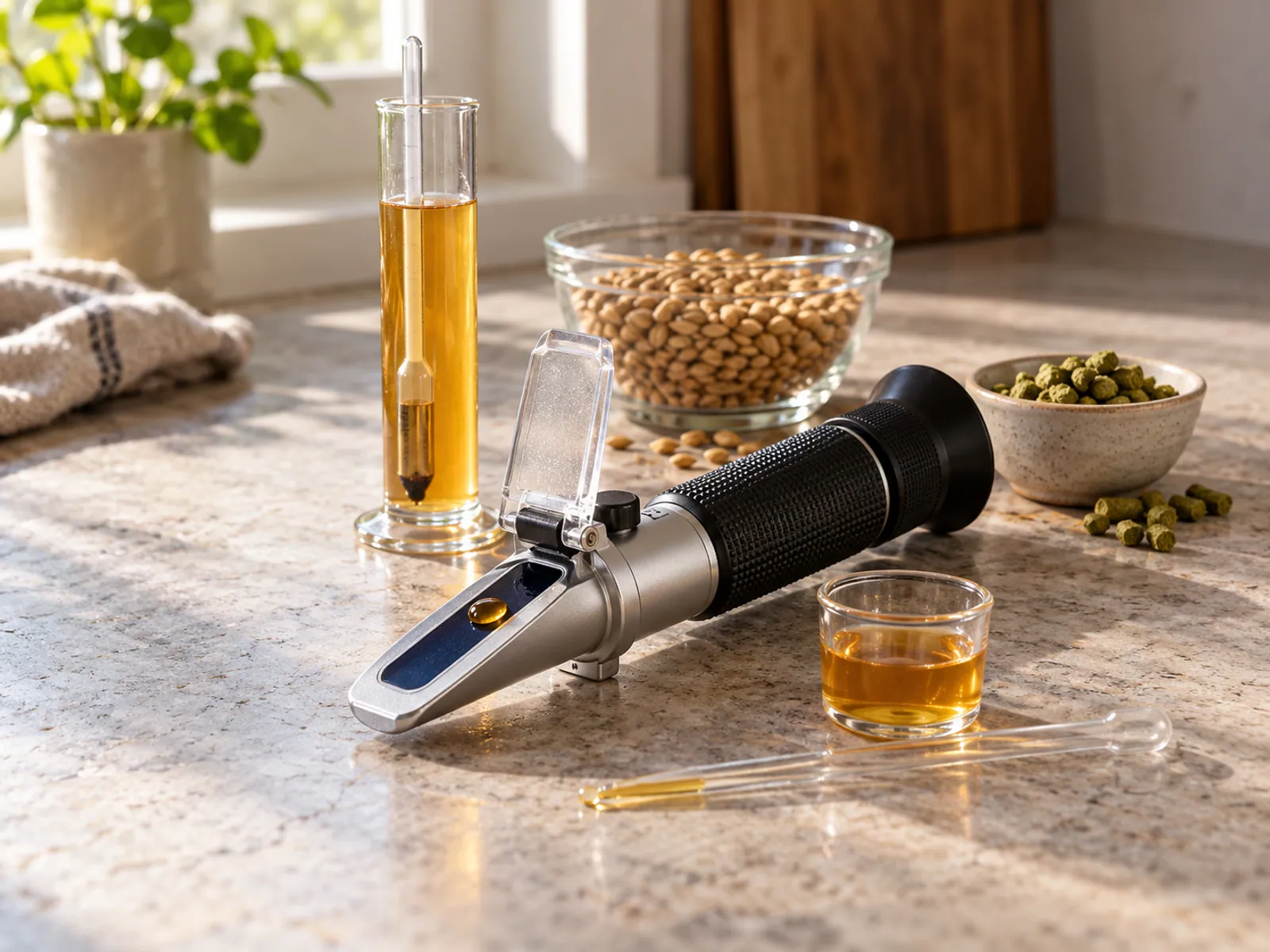
If attenuation reads above 100% or ABV looks impossible, check for a transposed reading or a decimal slip. Confirm the hydrometer reads 1.000 in plain water at its calibration temperature and correct for sample temperature when hot.
If gravity has stalled higher than expected, give the yeast warmth and time, rouse gently, and re-read after a couple of days before deciding the fermentation is truly stuck.
FAQ
Common questions about original gravity, final gravity, gravity points, ABV, and attenuation.
Calculators and guides for your next step.