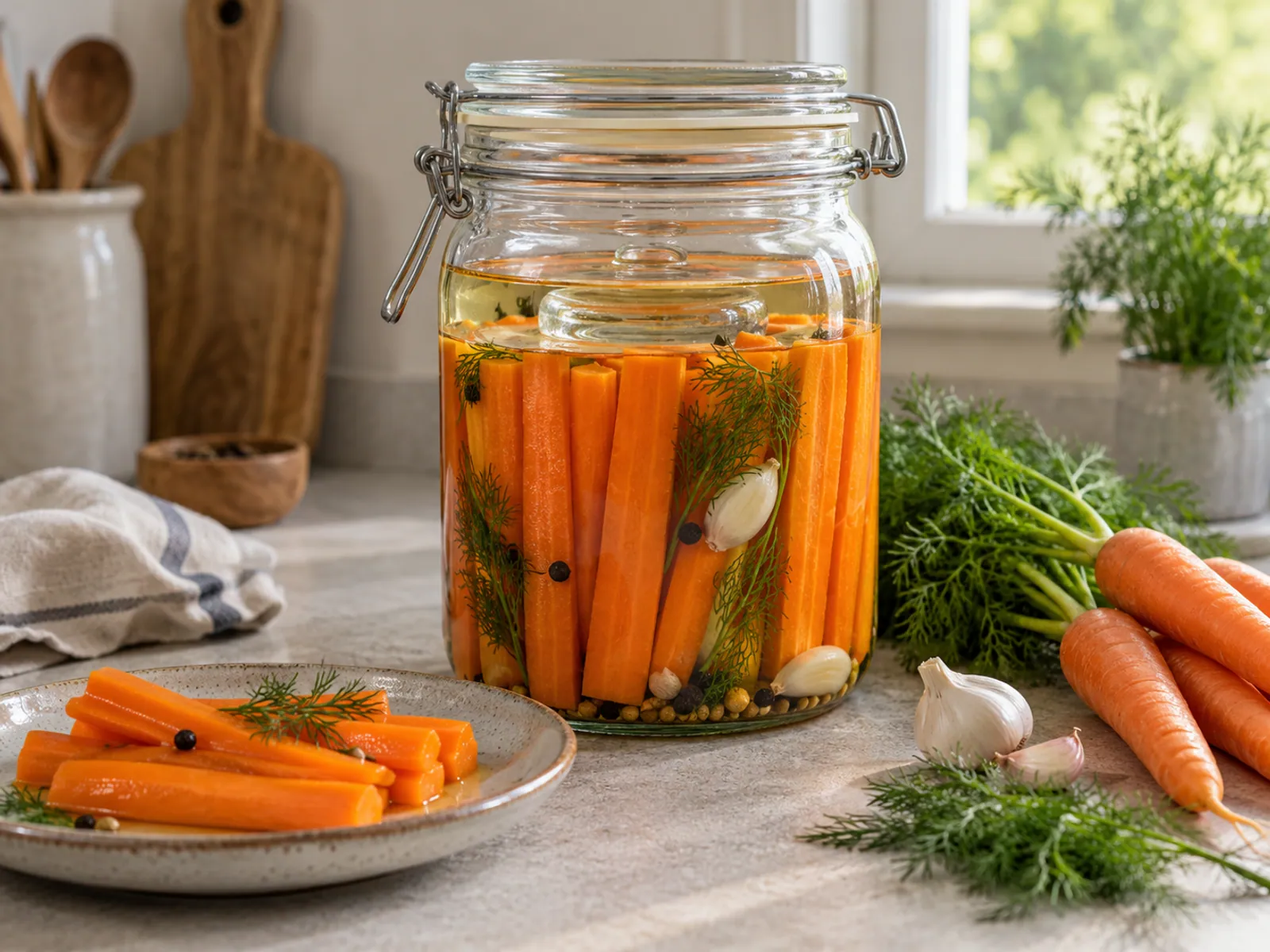
Fermented carrots are the easiest first ferment after sauerkraut. Carrots are dense, so they stay crunchy; they are sweet, so they ferment readily; and they take on garlic, dill and ginger beautifully. A jar is ready in about a week and becomes the kind of snack people eat straight from the fridge.
Fermented carrots recipe
- 1Cut the carrots Peel or scrub about 500 g of carrots and cut them into sticks a little shorter than your jar, or into thick coins.
- 2Add flavour Put 2–3 garlic cloves, a few sprigs of dill or a thumb of sliced ginger in the jar, then pack the carrots in upright and tight.
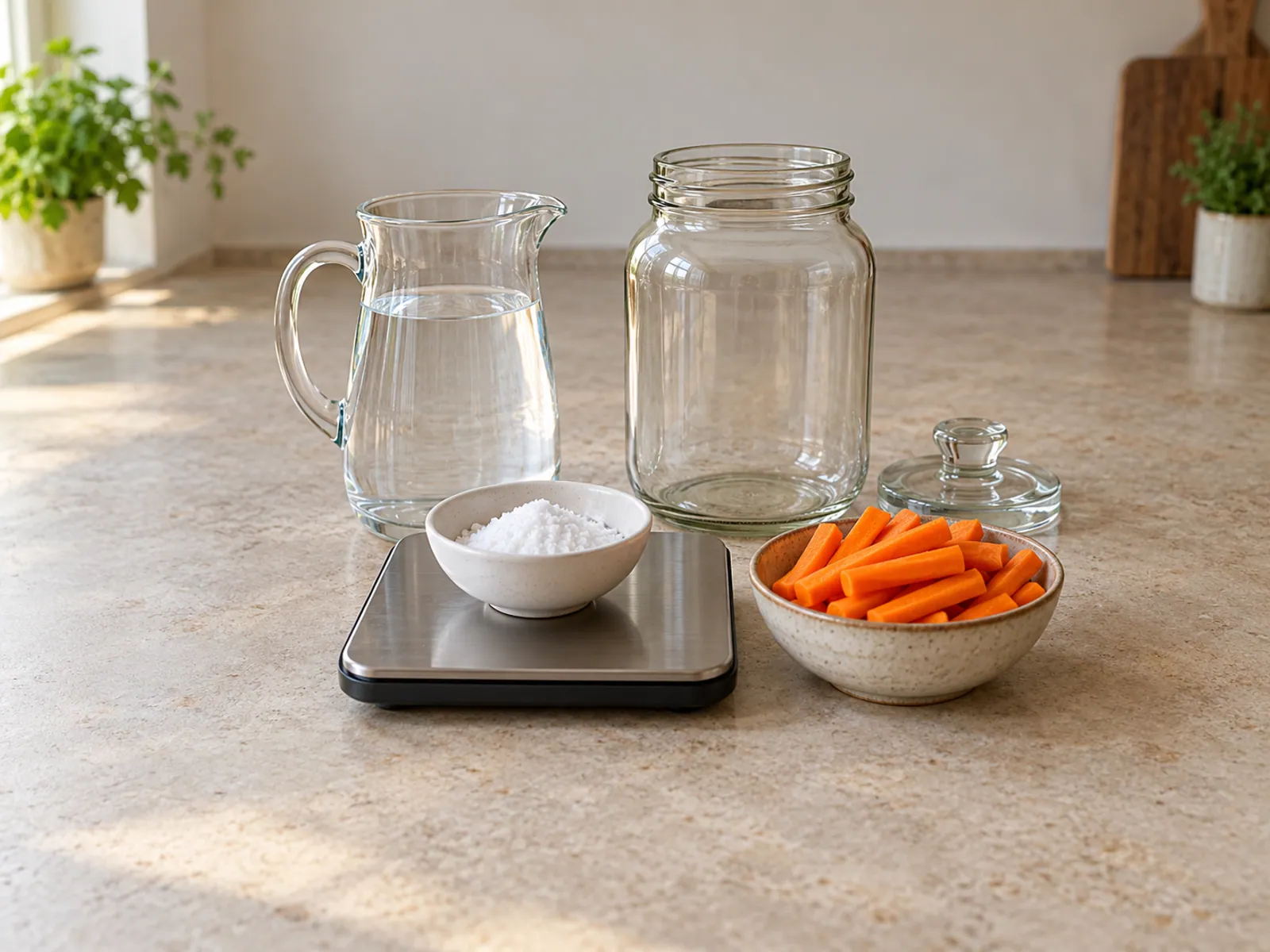
- 3Cover with brine Dissolve 20–30 g of non-iodized salt per litre of water. A quart jar of sticks needs roughly 400–500 ml of brine (8–15 g salt). Cover the carrots by 2 cm.
- 4Ferment Weigh them down so nothing floats, then ferment at 18–22°C with an airlock or a loose lid. The brine turns cloudy within a few days.
- 5Taste and refrigerate From day 4, taste a stick. When it is tangy but still crisp, usually days 5–10, seal and refrigerate.
Flavour combinations
Grated carrot relish
Grate the carrots, weigh them, and mix in 2% salt by weight (2 g per 100 g). Massage until juice pools, pack tightly into a jar so the juice covers them, and ferment for 3–5 days. Add grated ginger or a little shredded cabbage if you like. It is a quick, tangy topping for tacos, sandwiches and rice bowls.
Troubleshooting
Watch for
- Fuzzy or coloured mould, or a rotten smell Discard the batch.
More root vegetables and the general method are in fermenting root vegetables. For beets, radishes and the full list, see fermented beets, fermented radishes and fermented vegetables A–Z.
Related calculator
Fermentation Brine Calculator
Calculate salt using vegetables plus water, water only, or dry vegetable weight. Match the percentage and basis in your tested recipe.
Sticks, coins or grated carrots?
Match the cut to how you want to use the carrots. Sticks work as a snack and tuck into sandwiches; thick coins are useful in bowls; grated carrots make a softer relish. They are different preparations, so use the method written for the format you choose rather than applying one timing to all three.
For sticks, start with carrots of similar thickness. Quarter broad sections lengthwise and cut narrower sections to a comparable size. Trim their length so the weight and brine fit above them while leaving the headspace required by your vessel. A carrot sticking up through the liquid is not protected because most of the jar is submerged.
Pack firmly enough to limit floating, but leave room for brine to reach between the pieces. A suitable fermentation weight should sit on the vegetables rather than merely resting on the mouth of the jar. Inspect the sides after filling: air pockets trapped between sticks can often be released by gently settling the fresh-packed jar before fitting its lid.
Grated carrots release their own liquid more readily and cannot be swapped into a stick recipe without changing the preparation. The root vegetable guide compares these formats, while the fermentation brine calculator explains their different calculation bases.
Free Fermentation Salt Reference Card (printable PDF)
A printable PDF companion for the brine & pickling calculators and guides.
Calculate from the water you mix, not the jar label
If your selected recipe specifies a 2.5% water-based brine, 400 g water needs 10 g salt, while 600 g water needs 15 g. Both have the same concentration. A one-litre jar may hold much less than one litre of added water once carrots and a weight occupy it.
Mix the brine accurately in a separate container, dissolve the salt completely and pour in the amount the recipe requires. Do not add a litre’s salt allowance directly to a packed jar that only accepts 400 g water. Equally, do not top up a partly filled jar with plain water: that changes the brine you just calculated. The example illustrates arithmetic, not a universal carrot-fermentation recommendation.
Record carrot weight, cut, brine quantity, salt basis and temperature. If a second batch is noticeably softer, these notes let you compare the actual preparation rather than blaming the spice mixture.
Serving carrots without changing the storage jar
Lift out a serving with a clean utensil and keep the remaining carrots covered by their liquid. Chop a few sticks into a potato salad, slice them into a grain bowl or serve them alongside a rich sandwich. Add fresh herbs, citrus or oil to the plate rather than the main jar. These additions are serving ideas, not changes to the fermentation recipe.
Refrigerate according to your recipe’s instructions and label the batch with its start and refrigeration dates. Do not rely on a generic “keeps for months” claim when preparation and storage history are unknown. Refrigeration slows microbial activity; it cannot reverse spoilage or validate an incorrectly prepared batch.
If the texture is merely softer than you wanted and the batch otherwise meets its method’s checks, a finely chopped serving may suit a relish. Unusual slime, fuzzy growth or uncertain spoilage is a discard decision, not an invitation to blend it into a sauce.
A reference for the fermentation method
University of Minnesota Extension’s fermentation guidance distinguishes wet and dry brines and emphasizes using a tested recipe. Use the full method for your chosen preparation; a calculated salt quantity alone does not validate an ingredient substitution or storage period.