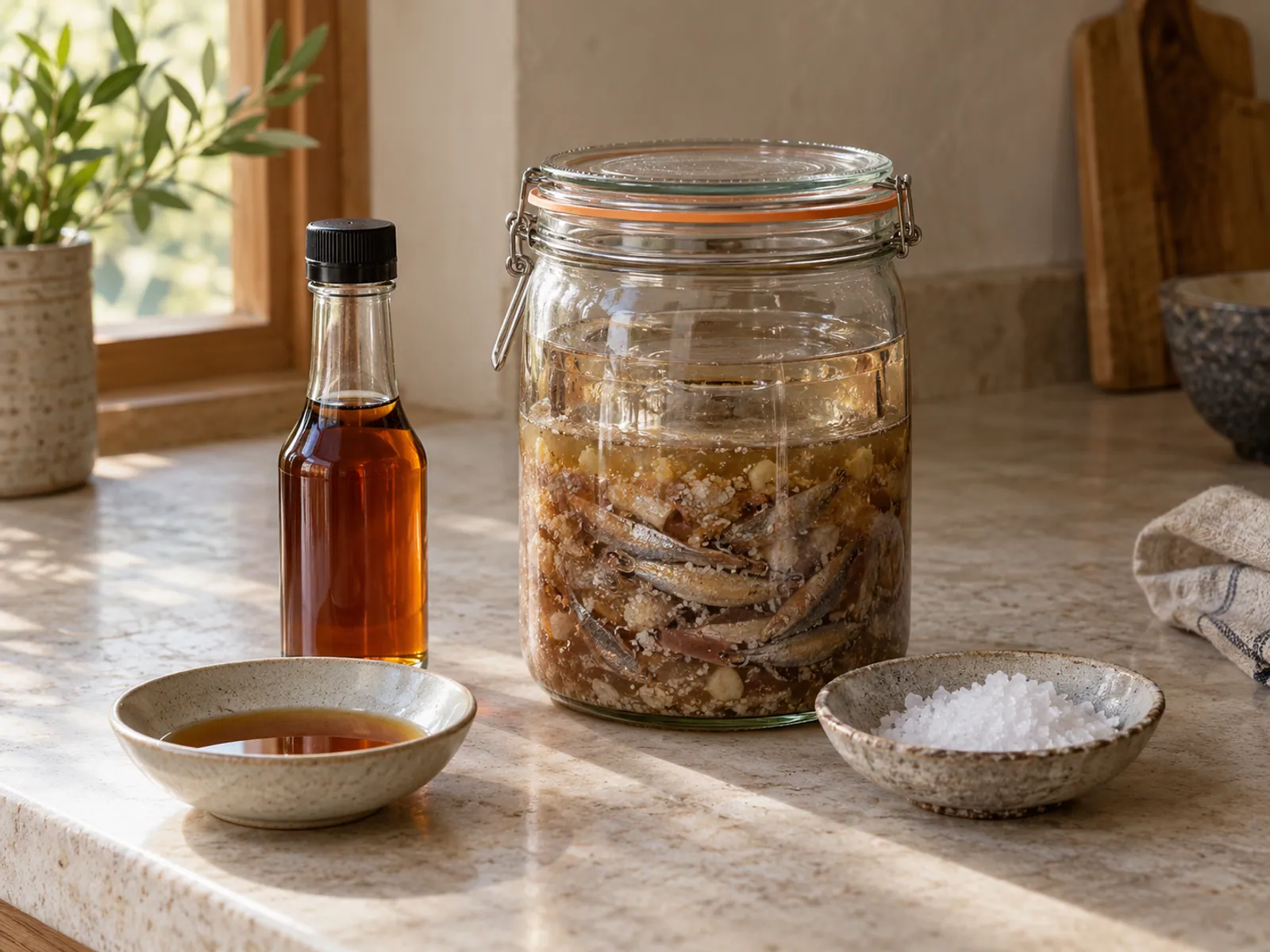
Fish sauce is fermentation at its most elemental — fish and salt, time and patience. Small fish are packed in salt and left for months until enzymes and halophilic bacteria break them down into an intensely savoury amber liquid that is the backbone of Southeast Asian, Korean, and ancient Roman cooking.
How fish sauce fermentation works
The process is driven by two forces working together: endogenous enzymes (naturally present in the fish, especially in the gut) that break down proteins into amino acids, and halophilic bacteria that thrive in the high-salt environment and contribute to flavour development.
- 1Protein breakdown Enzymes in the fish — primarily proteases from the gut and muscle tissue — break down proteins into peptides and free amino acids. Glutamate, the amino acid responsible for umami taste, accumulates as this happens.
- 2Bacterial fermentation Salt-tolerant (halophilic) bacteria, mainly Halanaerobium and Tetragenococcus species, metabolise the amino acids and produce flavour compounds — organic acids, aldehydes, and volatile aromatics that give fish sauce its complexity.
- 3Liquefaction Over months, the solid fish tissue dissolves into liquid. The salt draws water out of the fish and prevents putrefactive bacteria from taking hold. What remains is a clear to amber liquid rich in amino acids, salt, and flavour compounds.
Homemade fish sauce recipe
1 kg Fresh anchovies
300–400g Sea salt
6–12 months Fermentation time
~400–500ml Yield
- 1Mix fish and salt In a large, clean glass or ceramic jar, layer the fish with the salt — a layer of fish, a generous layer of salt, repeating until both are used. Mix thoroughly so every surface is coated. The salt should be 30–40% of the total fish weight.
- 2Pack and weight Press the mixture down firmly to eliminate air pockets. Place a weight on top (a plate topped with a clean stone or jar of water) to keep the fish submerged as it liquefies. The fish will release liquid within the first few days.
- 3Cover and store Cover the jar with cheesecloth or a loose lid — the ferment needs some airflow but protection from insects. Place it in a warm spot, ideally in direct sunlight if outdoors (traditional Thai and Vietnamese production uses solar heat to accelerate fermentation). Or keep it in a warm corner indoors.
- 4Stir occasionally For the first month, stir the mixture once a week to redistribute the salt and enzymes. After that, leave it alone. The fish will gradually dissolve into a murky liquid.
- 5First press After 6–12 months, the fish should be mostly liquefied. Strain through cheesecloth or a fine-mesh strainer. The clear amber liquid is your fish sauce. Let it settle in a clean jar, then decant off any sediment.
- 6Second press (optional) The strained solids can be re-packed with a lighter brine (10% salt water) and left for another 2–3 months for a second, milder extraction. The solids themselves are a fermented fish paste similar to Thai pla ra or Korean jeotgal.
Keys to success
Use enough salt 30–40% of fish weight is non-negotiable. Below 25%, putrefactive bacteria can take over and the batch goes rotten instead of fermented.
Use fresh fish fish that is already starting to spoil introduces the wrong bacteria. Fresh, whole, ungutted fish gives the best result.
Warmth accelerates traditional fish sauce is made in tropical heat (30–35°C). In a temperate climate, fermentation is slower — expect 9–12 months instead of 6.
Patience is everything the sauce improves dramatically from month 6 to month 12. Tasting early gives you an idea of progress, but the best sauce comes from the longest fermentation.
Watch for
- If the ferment smells putrid (rotting, not just fishy) or develops green, black, or pink mould, there was not enough salt or the fish was already spoiled. Discard it.
- Keep the fish submerged at all times — exposed fish above the liquid line will putrefy.
- Do not use iodised salt — the iodine can inhibit fermentation. Use sea salt, kosher salt, or pickling salt.
- Ferment outdoors or in a well-ventilated area — the smell during the first few months is very strong.
Free Fermentation Salt Reference Card (printable PDF)
A printable PDF companion for the brine & pickling calculators and guides.
How to use fish sauce
As a seasoning A splash in stir-fries, soups, curries, and marinades adds deep umami without a fishy taste. Start with 1 teaspoon and adjust — it is intensely salty.
In dressings and dips The base of nuoc cham (Vietnamese dipping sauce), Thai nam pla prik, and many Southeast Asian salad dressings. Mix with lime juice, sugar, chilli, and garlic.
As a secret weapon A few drops in pasta sauce, Caesar dressing, beef stew, or any savoury dish that needs more depth. The fish flavour disappears into a background umami boost.