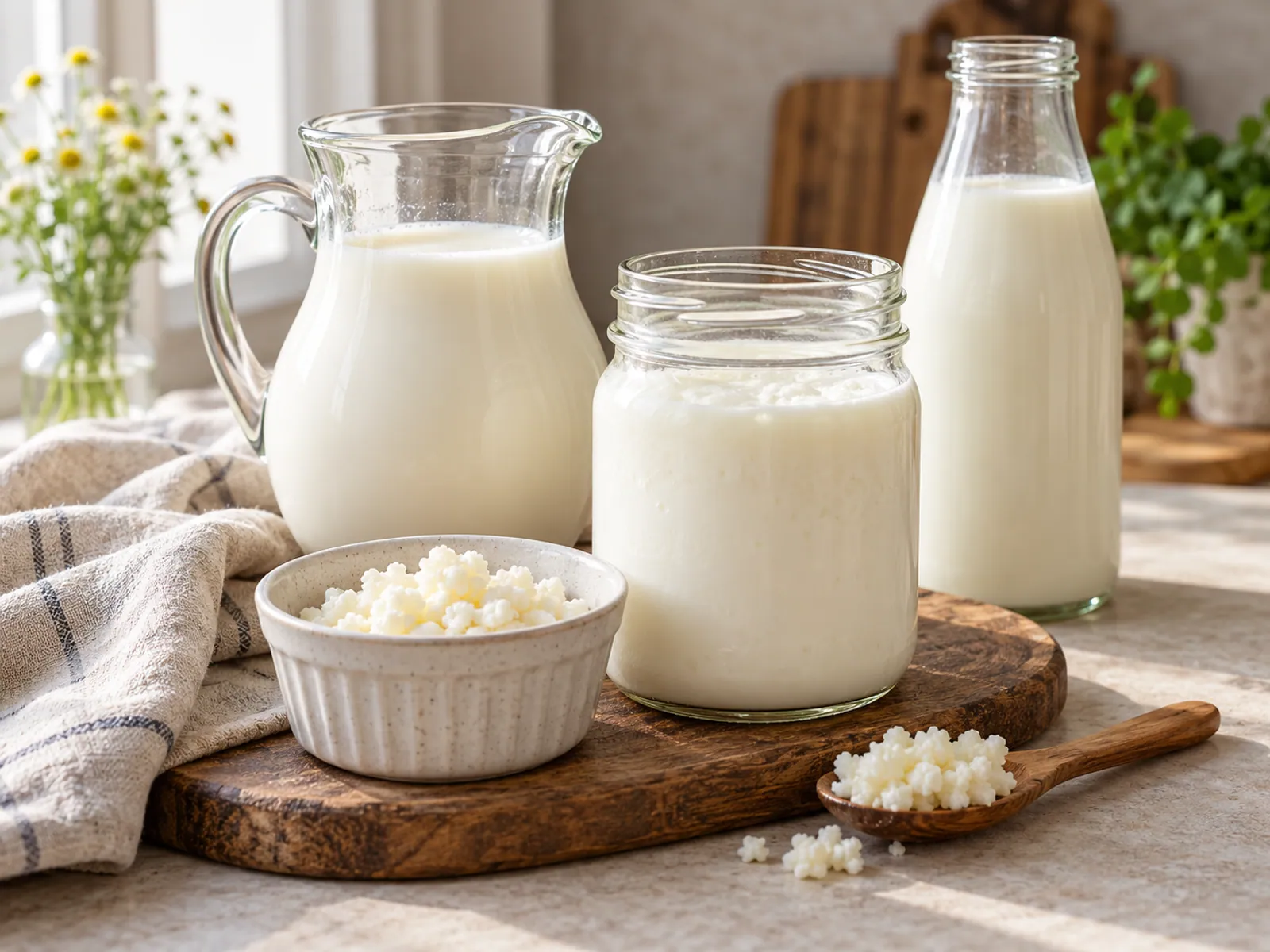

Low-sugar yogurt is not a special recipe, it is a process you steer. Plain yogurt has no added sugar to begin with, and the milk sugar it does contain, lactose, is exactly what the bacteria eat. Ferment longer and they consume more of it. Strain off the whey and you pour away more still. This guide shows how to use fermentation time, tartness, straining, culture choice, and unsweetened add-ins to land a yogurt (or kefir) that is genuinely low in sugar, while being honest about the one thing you cannot do: remove every last gram.
Where the sugar in yogurt comes from
There are two very different kinds of sugar in a tub of yogurt, and telling them apart is the whole game. The first is lactose, the natural sugar in milk. The second is added sugar: the cane sugar, honey, or fruit syrup that manufacturers stir into flavored yogurts. On a nutrition label they blur into one “sugars” figure, but they behave completely differently.
This is why homemade plain yogurt is the lowest-sugar starting point available: you skip the added sugar entirely, and then you can work the milk sugar down with fermentation. For the base method itself, the homemade yogurt guide walks through heating, culturing, and setting.
How fermentation lowers the sugar
Fermentation is a feeding process. The yogurt culture pulls lactose in and splits it with the enzyme lactase (beta-galactosidase) into two simpler sugars, glucose and galactose. It then burns most of that through into lactic acid, which is not a sugar at all. Lactic acid is what thickens the milk and gives yogurt its tang, and every gram of it started life as milk sugar that is no longer sweet.
The catch, and the reason this guide keeps you honest, is that the conversion is never total. Bacteria slow as the milk grows acidic and food runs low, and galactose in particular tends to linger. So the sugar figure falls a long way but never reaches zero. Think of it as a dial you can turn most of the way down, not an off switch.
This same mechanism is why fermented dairy sits easier on lactose-sensitive stomachs than fresh milk. If your goal is specifically the lactose rather than total sugar, the lactose-free yogurt guide covers the milk-base and lactase-drop angles in more depth.
Fermentation time vs. sugar left
The single biggest lever is how long you hold the milk warm. A quick set leaves plenty of sugar; a long one removes most of it. The figures below are working ranges at a typical incubation of 42-44C / 108-111F with standard yogurt strains, not lab-exact numbers, since milk, culture, and temperature all shift the curve.
Read the table against your own goal. Someone easing off sugar gently may be happy with a longer standard set, while anyone chasing the lowest number should stack a full 24-hour ferment with straining.
| Fermentation time | Approx. milk-sugar cut | Taste and texture | Best for |
|---|---|---|---|
| 4-6 hours | ~15-25% | Mild, soft, still slightly sweet | A regular set, not low-sugar |
| 6-12 hours | ~20-50% | Classic tang, firm set | A modest sugar reduction |
| 12-18 hours | ~50-70% | Sharper, slightly thinner | A meaningful cut |
| 24 hours | ~80% or more | Tart, sour, often needs straining | The lowest-sugar ferment |
| 24h + strained | Lower still per serving | Thick, concentrated, tangy | Lowest sugar per bowl |
Fermenting much past 30 hours does not lower sugar meaningfully further and starts to risk a starved, separated, or off-tasting batch, so 24 hours is the practical floor. To plan a batch size and starter amount around your chosen ferment, the homemade yogurt guide has the ratios.
Using tartness as your sugar gauge
You cannot see grams of sugar, but you can taste them leave. Because every bit of sugar the culture eats becomes lactic acid, sourness and sugar move in opposite directions: as one climbs, the other falls. That makes tartness a genuinely useful, if rough, proxy for how far a batch has gone.
Use it to compare your own batches at a fixed temperature rather than as an absolute meter. If today’s batch tastes noticeably more sour than last week’s at the same warmth, it has almost certainly gone lower in sugar. Taste as it ferments: when the tang reaches the level you want, chill it to slow the culture and lock the balance in.
Related calculator
Yogurt Starter Calculator
Calculate how much yogurt starter culture you need per litre or gallon of milk. Works with freeze-dried and fresh cultures.
Strain it Greek-style to cut sugar per serving
Long fermentation lowers the sugar concentration in the whole batch. Straining lowers the sugar in each bowl you actually eat, and it works on a different principle. When you strain yogurt through cloth, you pour off the whey, and the whey carries a large share of the remaining milk sugar with it. What stays behind is thicker, protein-dense, and lower in sugar per spoonful.
The two effects compound. A 24-hour ferment removes most of the milk sugar, then straining pours off much of what is left in the whey. That is why a homemade, long-fermented, strained yogurt can be one of the lowest-sugar cultured foods in your fridge.
For the full method, cloth choices, and how far to strain, see the Greek yogurt guide.
Free Kefir Ratio Reference Card (printable PDF)
A printable PDF companion for the kefir calculators and guides.
Choosing cultures for a drier ferment
Any culture that turns milk into yogurt is already reducing sugar, but the two traditional strains are the workhorses. Both feed hard on lactose and carry the lactase that splits it, so they drive most of the reduction during the ferment.
Reuse a plain live-culture yogurt or buy a measured freeze-dried starter for batch-to-batch consistency. Whichever you pick, keep it plain: a sweetened yogurt used as a starter just carries added sugar into your batch, defeating the point.
A low-sugar yogurt method, step by step
Put the levers together and the recipe is straightforward. This is the standard yogurt process pushed toward the low-sugar end with a long ferment and a strain.
- 1Heat and cool the milk Heat milk to about 82C / 180F to firm up the set, then cool to 42-44C / 108-111F before adding culture. Hot milk kills the bacteria.
- 2Inoculate with a plain starter Stir in a few tablespoons of live plain yogurt, or a freeze-dried starter, so the cultures spread evenly. No sugar goes in.
- 3Ferment long and steady Hold a steady 42-44C / 108-111F for the full time you want. Aim for 24 hours for the lowest sugar. A maker or an oven with the light on holds temperature best.
- 4Taste toward the end From about hour 12 on, taste occasionally. When the tang reaches your target, the sugar has fallen accordingly. Sharper means lower.
- 5Chill, then strain Refrigerate at least 4-6 hours to set and mellow, then strain through cloth to pour off sugar-carrying whey for a thicker, lower-sugar bowl.
Watch for
- Do not ferment much past 30 hours Little extra sugar comes out, and you risk separation and off flavors.
- Unstable temperature is the top cause of thin or grainy long-ferment yogurt. Use a maker or a reliably warm spot.
- Low-sugar is not zero-sugar a residual trace of milk sugar always remains, so this is not suitable as a sugar-free medical food.
Flavor without adding sugar
The fastest way to undo a careful low-sugar ferment is to spoon honey or jam over it. All that work on the milk sugar is dwarfed by a tablespoon of added sweetener. The fix is flavor that carries little or no sugar of its own.
If you genuinely want it sweeter without sugar, a pinch of a non-nutritive sweetener stirred in at serving time keeps the sugar count flat. The principle throughout is simple: do the sweetening, if any, on the plate and in small amounts, never in the batch.
Lower-sugar kefir, the same idea
Everything here transfers to kefir, which ferments the same milk sugar with grains rather than a yogurt starter. A longer, warmer kefir ferment leaves less sugar and a tangier, more sour drink, exactly as with yogurt. Because kefir’s culture is more diverse and more aggressive, a fully soured kefir is often lower in residual milk sugar than a short yogurt set, which makes it a strong low-sugar option if you prefer a drinkable ferment. If you are weighing the two, kefir vs. yogurt lays out the differences.
The main variable you control with kefir is the ratio of grains to milk, which sets how fast and how far the ferment goes. Dial that in first, then let taste tell you when the sugar has dropped to where you want it.