Water
The hydration range for most sourdough loaves.

Sourdough · Calculator
Use this baker's percentage calculator to turn your flour weight and ingredient percentages into exact gram weights for water, salt, starter, fat, and sugar.
Live calculator · updates as you type
Your recipe, weighed
960gtotal dough weight · 72.7% overall hydration with a 100% starter
What to do next
From your 500 g of flour at 70% hydration.
Free printable
A batch card made from your numbers, to save as a PDF or receive by email:
Log each feed, watch your starter rise in a 3D jar and record when it peaks. After two feeds it learns your own starter’s timing, so you know when it will be ready.
Baker's percentage guide
Baker's percentage is the language professional bakers use to write, scale, and compare recipes. Once your recipe is expressed as percentages of flour, you can make one loaf or ten without ever rewriting it.
Flour is always the anchor at 100% . Every other ingredient is weighed against it.
The hydration range for most sourdough loaves.
More starter ferments faster; less takes longer.
Enough for flavour and controlled fermentation.
ingredient ÷ flour × 100Example: 10g salt ÷ 500g flour = 2% salt. To get grams, multiply: 500 × 2 ÷ 100 = 10g .
Baker's percentage expresses every ingredient as a percentage of the total flour weight. Flour is always 100%. Water at 70% means 70g of water for every 100g of flour; salt at 2% means 2g per 100g of flour.
The percentages usually add up to well over 100%, and that's correct — they're each measured against flour, not against the whole dough.
Percentages make recipes portable. Two loaves at very different sizes can share the exact same formula, and you can compare any two recipes at a glance — a 75% dough is wetter than a 68% one, whatever their batch sizes.
It also makes troubleshooting easier. If a loaf is too slack, you adjust the water percentage; too bland, the salt percentage — small, precise changes rather than guesswork.
To scale, keep the percentages fixed and change only the flour weight. Doubling from 500g to 1000g of flour doubles every ingredient automatically — the loaf stays identical in character, just larger.
Working backward from a target dough weight is just as easy: adjust the flour until the total matches the size you need.
Starter contains both flour and water, so for precise work bakers sometimes calculate "total" hydration that includes the starter's water. A 100% hydration starter is half flour, half water by weight.
This calculator treats starter as its own percentage line for simplicity. For a deeper split, pair it with the starter feeding calculator and the hydration calculator.
| Ingredient | Percentage | Notes |
|---|---|---|
| Flour | 100% | Always the anchor. Every other ingredient is measured against it. |
| Water | 65–80% | Hydration. Lower is firmer and easier to shape; higher is more open and slack. |
| Starter | 15–25% | More starter speeds fermentation; less slows it down. |
| Salt | 1.8–2.2% | 2% is the common default for flavour and controlled fermentation. |
| Fat / sugar | 0–10% | Optional. Used in enriched and sandwich doughs for softness and flavour. |
FAQ
Quick answers for reading, writing, and scaling formulas.
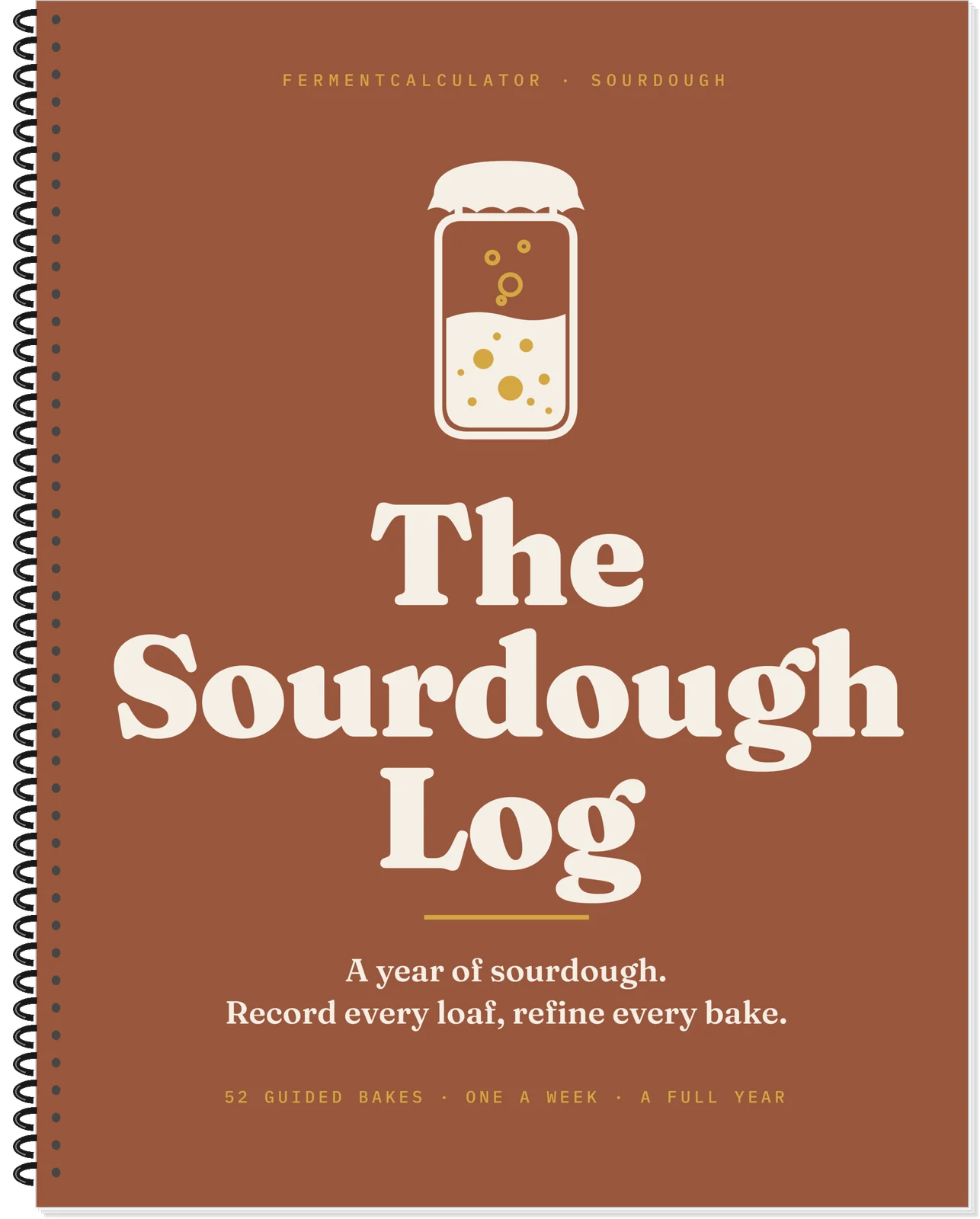
Printed book · Delivered to you
A spiral-bound book delivered to your door, ready to write in. 52 bake records in a spiral-bound journal that lies flat.
Digital download · Print at home
Download the files and print your own copy. No book is shipped. 52 guided bake spreads to download and print at home.
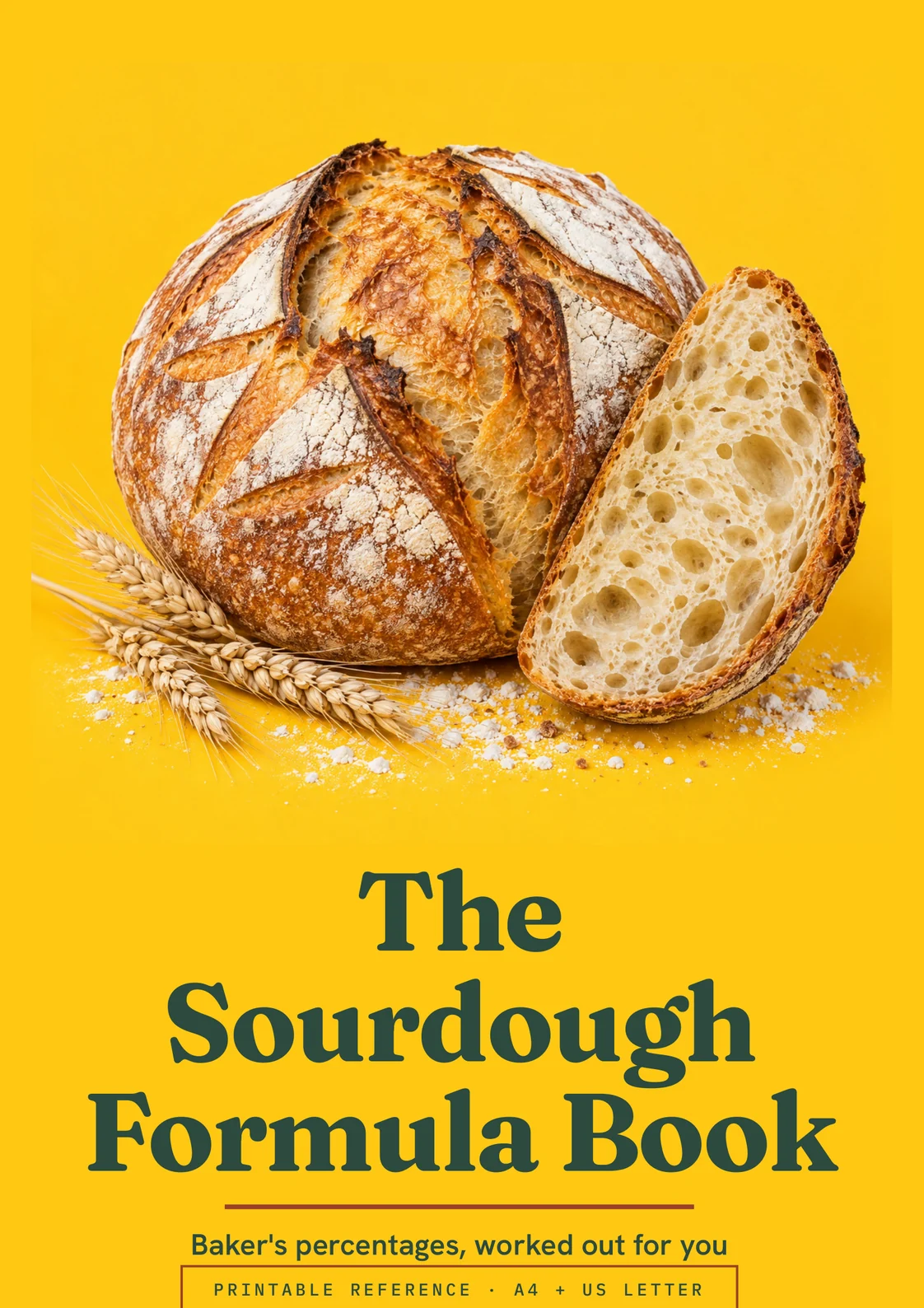
Digital download · Print at home
Download the files and print your own copy. No book is shipped. Baker's percentages, worked out for you.
Get the complete Sourdough Baking Playbook — all the calculators in one printable reference.
Calculators and guides for your next step.