Slow
About 1:30 by weight; begin checking at 24–30 hours.

Kefir · Calculator
Choose a slow, standard, or fast grain dose and get a practical check window for your milk volume.
Live calculator · updates as you type
Use drained grains
The reference range used for the calculator check windows.
What to do next
For 1.00 L of milk.
Free printable
A batch card made from your numbers, to save as a PDF or receive by email:
1 L milk on the standard protocol uses 50 g grains.
Grams are canonical. Tablespoons vary with grain size, drainage, hydration, and packing.The practical baseline for an active culture at ordinary room temperature.
Time, temperature, culture activity, and the straining point determine final sourness.Use pasteurized milk. If measured, finished milk kefir should be below pH 4.6.
If it does not fall below pH 4.6 within 36 hours, treat the process as failed.| Protocol | Grains | Ratio | Check |
|---|---|---|---|
| Slow | 33 g/L | 1:30 | 24–30 h |
| Standard | 50 g/L | 1:20 | 18–24 h |
| Fast | 100 g/L | 1:10 | 12–18 h |
A pace model, not a taste promise
Milk-kefir grain dose influences speed, but it does not work alone. Use grams for the starting ratio, temperature for context, and the batch itself for the stopping decision.
About 1:30 by weight; begin checking at 24–30 hours.
A 1:20 baseline; begin checking at 18–24 hours.
A 1:10 high-dose protocol; begin checking at 12–18 hours.
litres × g/L = grain gramsExample: 1.5 L on the standard 50 g/L protocol needs 75 g of drained milk-kefir grains.
The three settings describe process speed: slow, standard, and fast. They are not mild, balanced, and tangy buttons because flavour is also driven by temperature, time, milk, and the stopping point.
Start with standard at 50 g/L. Change one variable at a time and write down what happened before changing the protocol again.
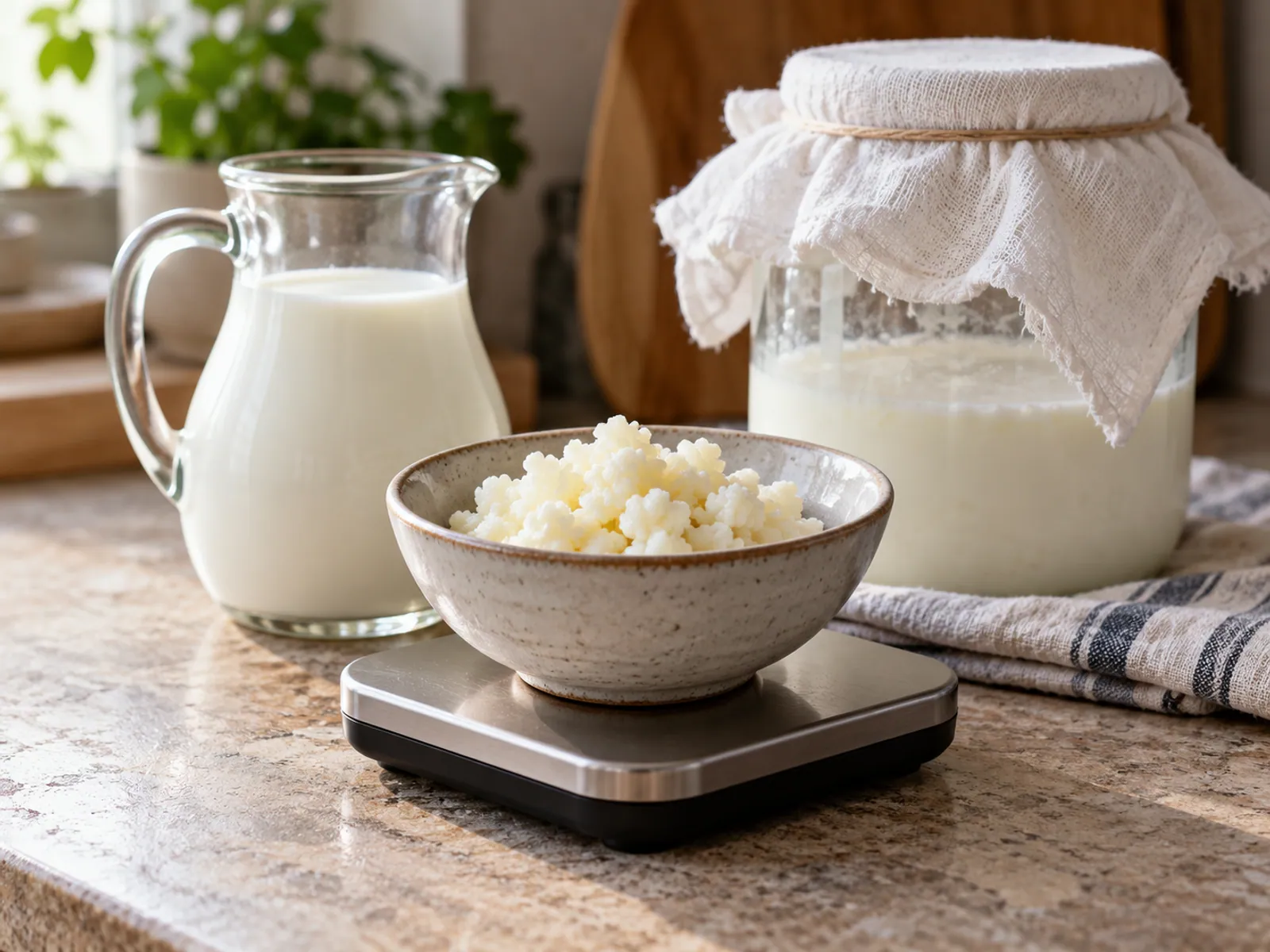
Drain consistently, then weigh. A tablespoon can contain roughly 12–15 g, but grain size, hydration, and packing make volume measures too variable for precise batch comparisons.
For 1 L of milk, the three anchors are about 33 g, 50 g, and 100 g. Multiply the selected dose by your milk volume.
Below 18°C, activity may become very slow. From 18–20°C expect the longer end of the window; 21–23°C is the standard reference band; 24–26°C is warmer and requires earlier checks.
Above 26°C, watch the jar closely. Do not convert temperature into a falsely precise finish time.
Pasteurized whole cow’s milk is the easiest baseline. Lower-fat milk usually gives a thinner body; goat milk can set more softly; lactose-free dairy may behave differently by brand.
Oat and other plant drinks are not nutritionally equivalent to dairy milk for maintaining traditional milk-kefir grains. Use them only as an occasional separate experiment, not the default feeding medium.
Too sour or separated usually means the ferment went too far for your target. Thin or slow kefir can reflect cool conditions, weak grains, a low dose, or a culture still adapting.
If grains shrink, return to a simple pasteurized dairy routine, use the standard protocol, and avoid changing milk, temperature, and feeding interval all at once.
Use pasteurized milk and clean equipment. If you measure pH, finished milk kefir should be below 4.6.
If the batch fails to reach pH 4.6 within 36 hours, or shows mould, unusual colour, or an objectionable odour, discard it. Taste is not a safety test.
FAQ
Quick answers on grain doses, timing, and what changes a batch.
Keep the milk-grain protocols, water-kefir sugar levels, check windows, and batch notes in one printable quick-reference sheet.
Calculators and guides for your next step.