Light
A lower starting sugar load for controlled comparison.

Kefir · Calculator
Scale 45, 55, or 70 grams of sugar per litre without turning sugar level into a false timing or fizz promise.
Live calculator · updates as you type
Sugar for this batch
Start checking at 24 hours. Many home recipes run for 48–72 hours, while traditional processes may take 2–4 days. Culture activity, grain dose, sugar, water chemistry, temperature, and recipe all affect timing.
What to do next
For 1.00 L of water kefir.
Free printable
A batch card made from your numbers, to save as a PDF or receive by email:
Clean flavour and low mineral contribution. Judge mineral support from the water and grain behaviour.
Use ordinary fermentable sugar for the first ferment; non-caloric sweeteners do not replace it.Start without an automatic boost, then change one variable only if activity stays weak.
Mineral needs depend on the combined water and sugar profile, so there is no universal addition.Water kefir naturally produces alcohol. The amount varies with culture, sugar, temperature, time, oxygen exposure, and sealed second fermentation. Home water kefir is not guaranteed to be alcohol-free.
Use bottles manufactured for carbonation; avoid decorative glass, square bottles, and ordinary jars. Added fruit, juice, ginger, or sugar can accelerate pressure. Refrigerate before opening, open slowly over a sink and away from your face, and never treat a fixed time or burping schedule as a pressure guarantee.| Level | Per litre | 1 litre batch | Grain dose |
|---|---|---|---|
| Light | 45 g/L | 45 g | 60 g/L |
| Standard | 55 g/L | 55 g | 60 g/L |
| Rich | 70 g/L | 70 g | 60 g/L |
These are starting points, not sweetness guarantees. Fermentation time and culture activity determine how much sugar remains.
Sugar is one variable
A consistent sugar ladder makes testing useful. Keep grain dose stable, record the water and room temperature, and compare finished batches rather than assuming more sugar always performs better.
A lower starting sugar load for controlled comparison.
The default starting point for a new routine.
A higher starting load—not a promise of speed or fizz.
litres × g/L = sugar gramsExample: 1.5 L at the standard 55 g/L level needs 82.5 g sugar. Weighing is more repeatable than cups or spoons.
Select 45, 55, or 70 grams of sugar per litre, then scale that concentration to the actual water volume. The calculator keeps grams primary and shows tablespoons and cups only as kitchen approximations.
If you are establishing a routine, start at 55 g/L. Keep the grain dose, temperature, and timing stable before comparing another level.
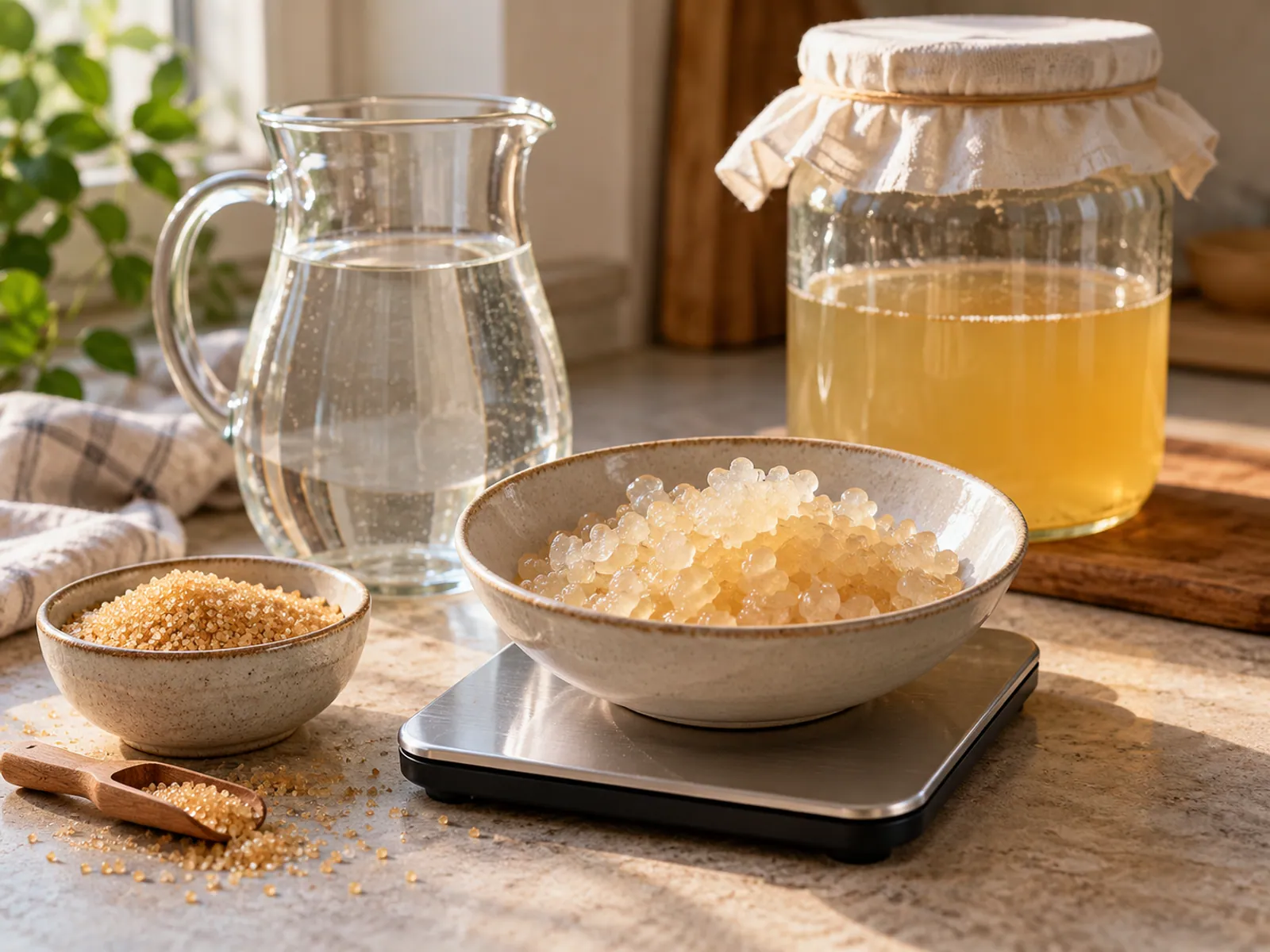
White cane sugar gives a neutral, repeatable baseline. Golden and whole cane sugars add flavour and minerals. Coconut sugar changes both more strongly and is best introduced gradually.
Avoid treating one sugar as universally superior. The useful choice is the one your grains handle consistently in combination with your water.
Mineral demand belongs to the whole recipe. Refined sugar plus low-mineral water may need support; mineral-rich water or less-refined sugar may already provide enough.
If a culture is weak, adjust one factor at a time. Automatically combining molasses, eggshell, dried fruit, mineral drops, and hard water can overshoot.
Begin observing around 24 hours, but expect many home batches to take 48–72 hours. Traditional methods can extend to two to four days.
More starting sugar does not automatically mean a faster ferment. Culture strength, room temperature, water, and microbial balance all matter.
Fruit or added sugar can provide fermentable material after straining, but the response is not perfectly predictable. Bottle condition, temperature, yeast activity, and time determine pressure together.
Use measured additions, carbonation-rated bottles, and conservative observation. Refrigerate before opening.
Water kefir may contain variable alcohol, especially after a sealed second ferment. Homemade batches cannot be assigned one universal ABV.
A burping schedule is not a safety guarantee. Use the right bottle, leave headspace, monitor the ferment, chill promptly, and open cold away from faces and breakable objects.
FAQ
Quick answers on grain doses, timing, and what changes a batch.
Keep the milk-grain protocols, water-kefir sugar levels, check windows, and batch notes in one printable quick-reference sheet.
Calculators and guides for your next step.