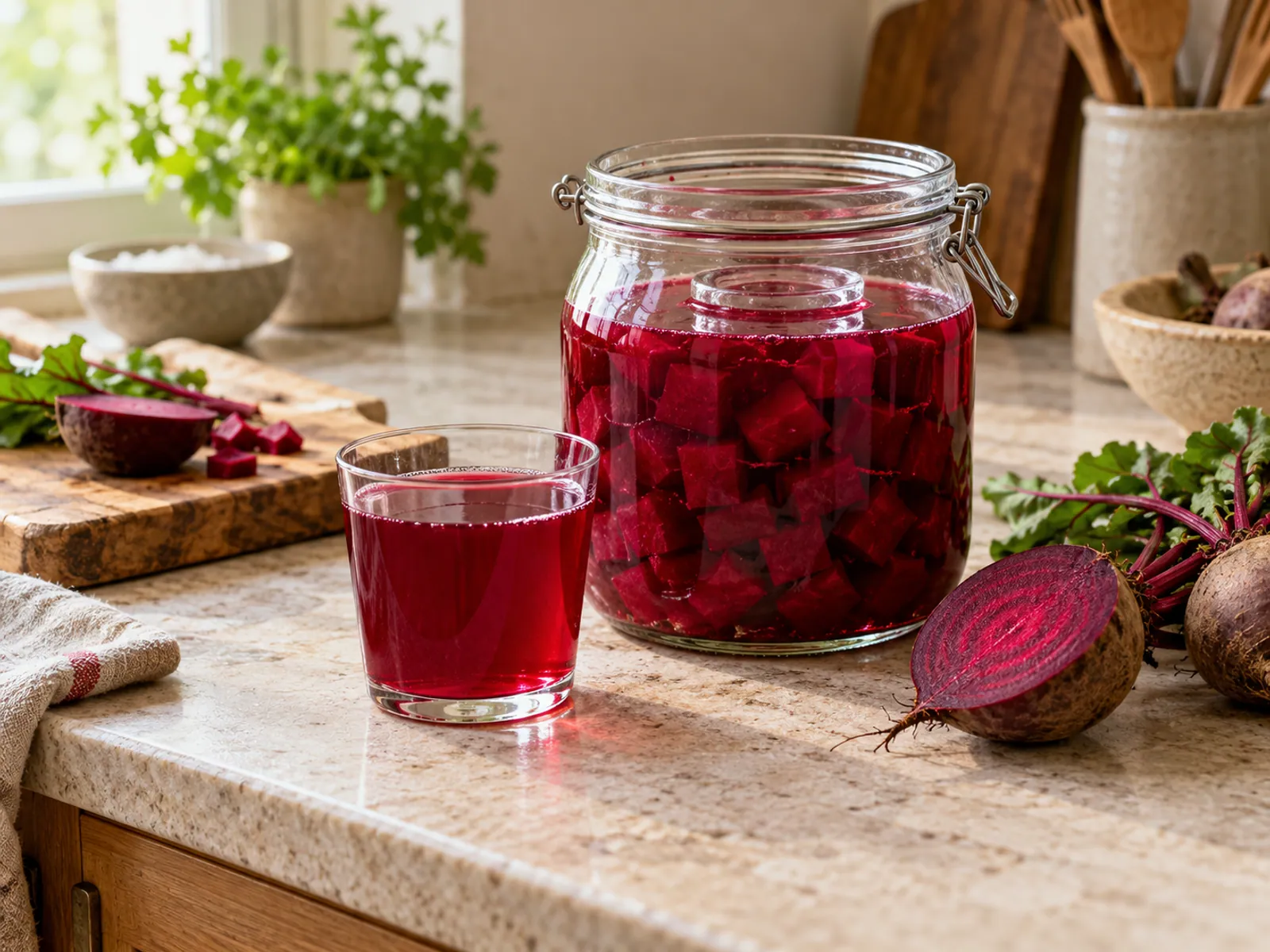
Beet kvass comes from Ukraine and Eastern Europe, where it was kept as a tonic and as the sour base for borscht. It is the simplest ferment you can make: beets, salt and water in a jar. What comes out is a jewel-red, salty-sour drink full of lactic acid bacteria.
Beet kvass recipe
- 1Cut the beets Peel 2 medium beets (about 250 g) and cut them into 2 cm cubes. Put them in a 1 litre jar; they should fill about a third of it.
- 2Make the brine Dissolve 10–20 g of salt in 1 litre of unchlorinated water. Use the concentration and temperature specified by your chosen method. Pour it over the beets, leaving 3 cm of headspace.
- 3Check the method Use a complete recipe and its specified culture, if any. Old brine is not a substitute for correctly measured salt or process checks.
- 4Ferment Cover with a loose lid or an airlock and keep at 18–22°C for 3–7 days. Make sure the beets stay submerged.
- 5Strain and chill When it is deep red, slightly thick and pleasantly sour, strain it into bottles and refrigerate.
- 6Plan the next batch Use fresh ingredients for a repeatable batch. Do not assume a second extraction from used beets follows the same process as the original recipe.
Flavour additions
If you want to eat the beets rather than drink them, see fermented beets, which uses a stronger brine for a crunchy pickle.
Troubleshooting
Watch for
- Surface film Assess cautiously; discard uncertain or fuzzy growth rather than identifying it by color alone.
- Fuzzy mould Discard the batch.
- Unexpected slime or ropiness Do not assume it is harmless. Discard a batch with suspected spoilage.
- Yeasty or unexpected alcoholic character Review the whole method and conditions; do not try to fix the batch by adding extra salt.
Brine weight, beet weight and jar capacity
Beet quantity and brine concentration answer different questions. The beets supply flavor and occupy space; the poured brine has its own calculation basis. A one-litre jar filled partly with beet cubes cannot hold another full litre of water.
For a recipe specifying 2% salt relative to water, 600 g water needs 12 g salt. That is different from 2% of the combined weight of, for example, 250 g beet and 600 g water, which would require 17 g. These are arithmetic examples: use the definition in your recipe, not whichever number looks more familiar.
Record beet weight, cube size, water weight, salt grams and temperature. Use the fermentation brine calculator when checking a method. Do not increase salt to compensate for unsuitable temperature or assume a diluted second extraction is equivalent to a fresh batch.
Earthy, citrus or savory: choose a serving use
Beet kvass is a salty, sour preparation rather than a sweet bread drink. Taste expectations matter: someone expecting berry soda may interpret its earthiness as failure. For a batch meeting its method’s checks, serve a small amount chilled or use a little as the sour component of a dressing or cold beet dish.
Ginger adds warmth, dill suits a savory dish and citrus can brighten the serving. Try those additions in a glass or small serving portion first; keep the storage jar in its original condition. Use a separate bowl for a dressing containing oil rather than pouring oil into the ferment.
A colorful drink is not a treatment or a required daily supplement. Choose portion size for flavor and your dietary needs, including sodium. For the distinct toasted-bread drink, see traditional bread kvass; for a vegetable to eat, see fermented beets.
Surface growth, unusual texture and storage
Do not identify a surface film by color alone. Fuzzy growth or uncertain spoilage calls for discarding the batch rather than skimming and drinking it. Unexpected ropiness or slime should not be dismissed as a harmless phase without method-specific evidence.
Keep finished kvass refrigerated according to the method used, label it and use clean utensils. Avoid assuming its alcohol level from its salty taste or short fermentation. If a batch fails, compare ingredient quantities, temperature, coverage and vessel hygiene before starting again; an extra spoon of salt is not a cure for deterioration.