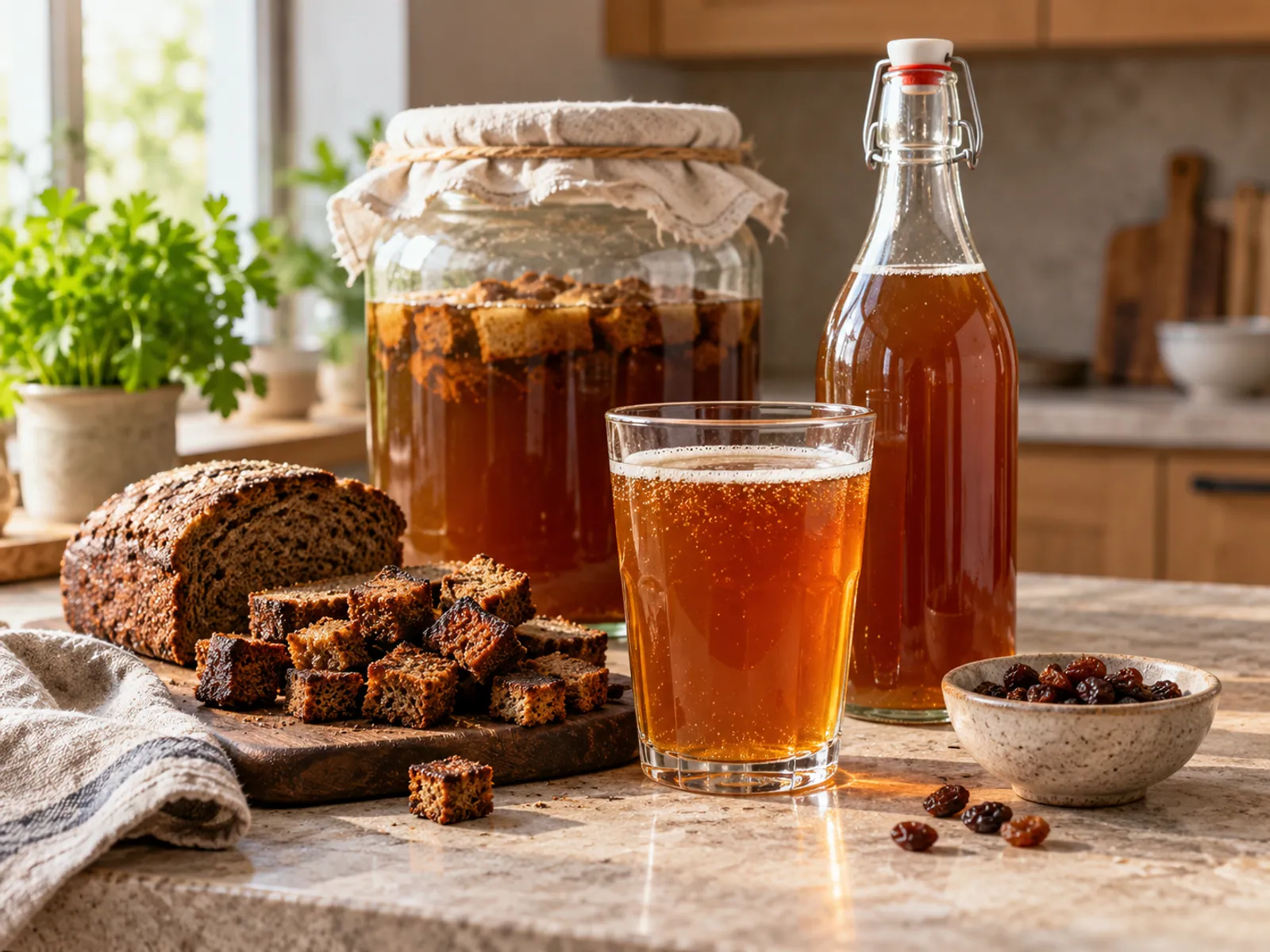
Kvass has been brewed in Russia, Ukraine, Poland and the Baltics for a thousand years, once in every household and still sold from street tanks in summer. It is made from stale rye bread, a little sugar and yeast, and it tastes like a sweet, malty, gently fizzy cross between soda and dark beer.
Bread kvass recipe
- 1Toast the bread Slice 500 g of dark rye bread and dry it in a 180°C oven for 20–30 minutes, until deep brown but not burnt. The toasting gives kvass its colour and malty flavour.
- 2Steep Put the toasted bread in a large pot or crock, pour over 3 litres of boiling water, cover and leave for 6–8 hours or overnight until completely cool.
- 3Strain Strain through a fine sieve or cloth, pressing gently. Do not squeeze too hard or the kvass turns cloudy and pasty.
- 4Sweeten and add yeast Stir in 150–200 g of sugar and 1/4 teaspoon of dried yeast (or 2–3 tablespoons of rye sourdough starter). Add a few mint leaves if you like.
- 5Ferment Cover with a cloth and leave at room temperature for 12–24 hours, until foamy and slightly sour.
- 6Bottle Strain again into pressure-rated bottles, add 2–3 raisins to each, seal, and leave 8–12 hours at room temperature until fizzy. Then refrigerate.
Variations
The bread tradition behind kvass, and other fermented breads, is covered in specialty fermented breads.
Troubleshooting
Watch for
- Too sour It fermented too long or too warm. Shorten the first ferment and chill sooner.
- Flat The bottles did not seal or were chilled too soon. Leave them a few more hours at room temperature.
- Bitter The bread was burnt. Toast it dark brown, not black.
- Mould on the bread during steeping The steep went too long in a warm room. Keep it to 8 hours or steep in the fridge.
Choosing bread and keeping a useful batch record
Bread is the main flavor ingredient, so use a loaf you enjoy rather than treating all stale bread as equivalent. Rye contributes a distinctive malty, grainy character; caraway or coriander in the loaf also becomes part of the drink. Record the loaf and its ingredients when comparing batches. Bread containing rye or wheat also means this drink is not suitable for someone avoiding gluten.
Stale bread and spoiled bread are different. Use sound bread that has dried out, not bread with mold or uncertain storage history. Toast to develop flavor without charring it: burnt patches can dominate the strained liquid. The amount of liquid retained in soaked bread means the water you start with is not necessarily the volume you bottle.
For the existing recipe’s 3 L water basis, 500 g bread and 150–200 g sugar correspond arithmetically to about 167 g bread and 50–67 g sugar per litre of starting water. That comparison helps record a batch; it does not establish a new fermentation or bottling schedule for a smaller vessel. Follow a complete method for the batch you make.
Bread kvass variations without confusing the methods
A darker rye loaf, a lighter rye-wheat loaf and a seeded loaf create different flavors before any extra ingredient is added. Start there if you want to compare results. Add fresh mint or a slice of citrus to the glass for a serving variation without changing the fermentation batch.
A sourdough-based method introduces a different culture from a measured dried-yeast recipe. Do not assume a spoonful of starter makes the same timing predictable; use a method developed for that culture. Likewise, replacing sugar with honey changes more than sweetness and should follow a recipe written for it.
Beet kvass is a different preparation based on beets, salt and water. Do not transfer bread kvass sugar or yeast quantities to beet kvass, or use beet brine as a substitute for the bread recipe’s culture. Keeping these two base methods separate makes each easier to understand and repeat.
Alcohol, sweetness and bottle pressure
A short fermentation does not guarantee a particular alcohol level. Remaining sweetness does not show how much sugar has already fermented, and chilling does not remove alcohol. If you need an alcohol-free drink, choose one with a reliably established alcohol specification rather than an unmeasured homemade kvass.
Bottling a sweet, active drink can build pressure. Raisins and other additions add variable fermentable material, so a fixed number of hours cannot guarantee carbonation or bottle safety. Use a suitable method and pressure-rated equipment; an ordinary storage jar is not a bottle-conditioning vessel. Keep finished kvass refrigerated as the recipe directs. For process-specific questions, use the fermented drinks guide and the fermentation FAQ.