Pickling minimum
Tested canning recipes assume vinegar of at least 5% acetic acid.
Vinegar · Calculator
Turn a titration reading into percent acidity, predict how strong your vinegar will get, or dilute it to 5% for pickling.
Live calculator · updates as you type
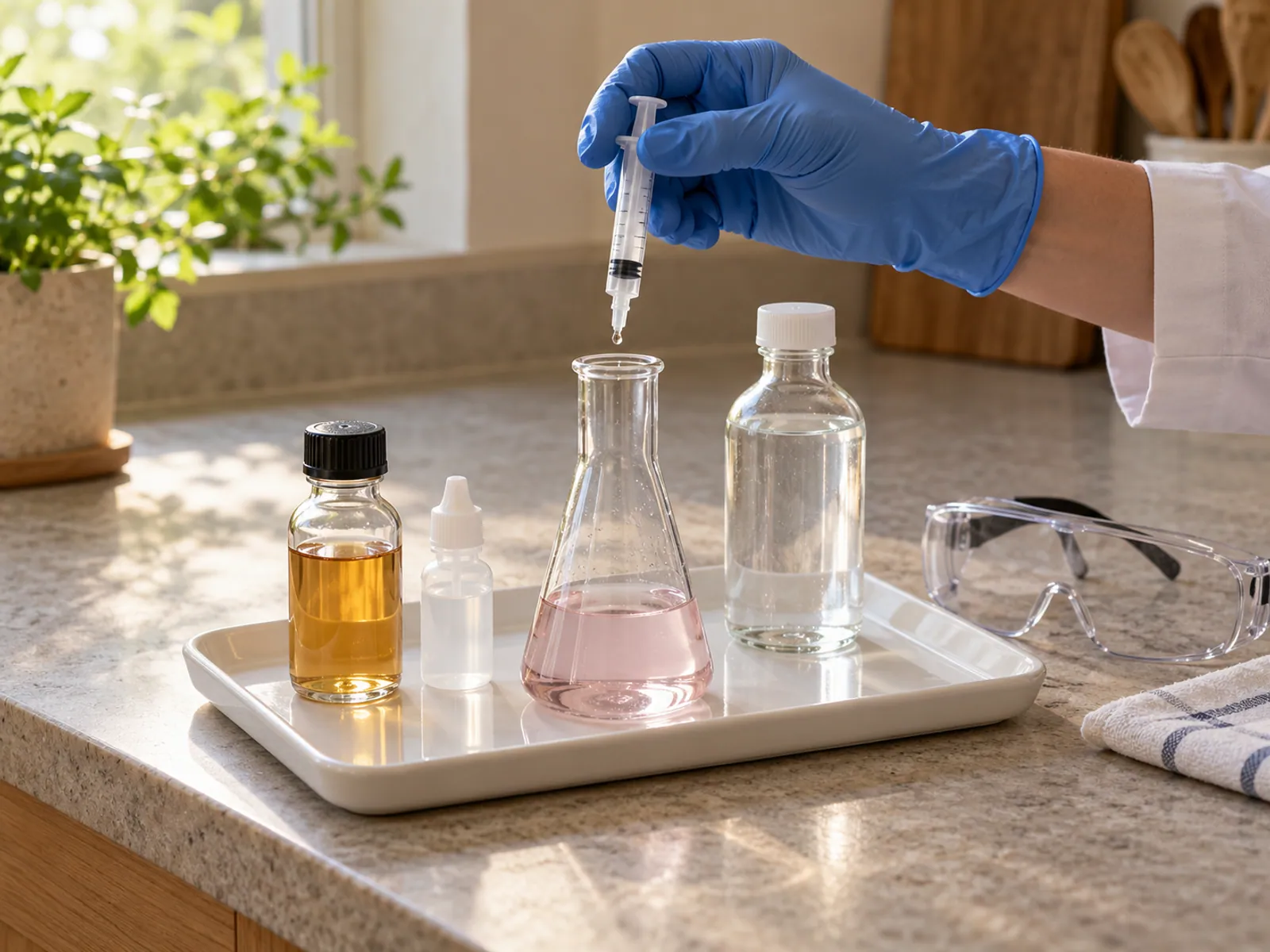
The test solution is the sodium hydroxide in a wine acid test kit; its strength is printed on the bottle, usually 0.2 N. Dilute 2 mL of vinegar in about 20 mL of distilled water, add a few drops of the indicator, then add test solution until the colour stays pink for 30 seconds.
Result
What to do next
From your titration test.
Free printable
A batch card made from your numbers, to save as a PDF or receive by email:
| NaOH used | Acidity | Use |
|---|---|---|
| 5.0 mL | 3% | Dressings, cooking |
| 6.7 mL | 4% | Table vinegar |
| 8.3 mL | 5% | Pickling (5%+) |
| 10.0 mL | 6% | Pickling (5%+) |
| 11.7 mL | 7% | Pickling (5%+) |
| 13.3 mL | 8% | Dilute before use |
Know your strength
Homemade vinegar can be anywhere from 3% to over 7% acidity, and you cannot taste the difference reliably. Test it, then use the result to decide whether it goes into a pickle, a dressing or the next batch.
Tested canning recipes assume vinegar of at least 5% acetic acid.
Each 1% alcohol makes up to about 1% acidity; home batches land a little lower.
0.2 N sodium hydroxide for a 2 mL sample of 5% vinegar.
Acidity % = mL NaOH × N × 6.005 ÷ sample mLN is the normality of the sodium hydroxide (0.2 in most wine acid kits). 6.005 converts to grams of acetic acid per 100 mL. To dilute: water = volume × (current % ÷ target % − 1).
You need a wine acid test kit (0.2 N sodium hydroxide, phenolphthalein indicator and a syringe or burette), distilled water and a small glass.
Measure exactly 2 mL of vinegar into the glass, add about 20 mL of distilled water and 3 drops of indicator. Add sodium hydroxide 0.5 mL at a time, swirling, then drop by drop as the pink flashes start to linger. Stop when a faint pink holds for 30 seconds and note how much you used.
2 mL sample, 0.2 N sodium hydroxide, 9.0 mL usedAcidity = 9.0 × 0.2 × 6.005 ÷ 2 = 5.4%Strong enough for recipes that call for 5% vinegarAcetic acid is a weak acid, so most of it does not show up as pH. A 3% and a 6% vinegar can read almost the same pH, around 2.5–3. pH tells you vinegar is acidic; titration tells you how much acid is in it, which is the number canning and pickling recipes are built on.
Acetic acid bacteria turn alcohol into acid, so the alcohol you start with caps the acidity you can reach.
Strong homemade wine vinegar can reach 7–8%. To bring it to 5%, add water = volume × (current ÷ target − 1). One litre of 7% vinegar needs 400 mL of water. Use distilled or boiled and cooled water, then retest if the vinegar is going into a canning recipe.
Below 4% usually means the base was low in alcohol, the batch was not finished, or alcohol evaporated in a warm spot. Taste for any alcohol: if it is still there, give it more weeks. If it is fully sour but weak, use it for dressings and cooking, and start the next batch from a stronger cider or wine. Never use weak vinegar to can or pickle for the shelf.
FAQ
Calculators and guides for your next step.